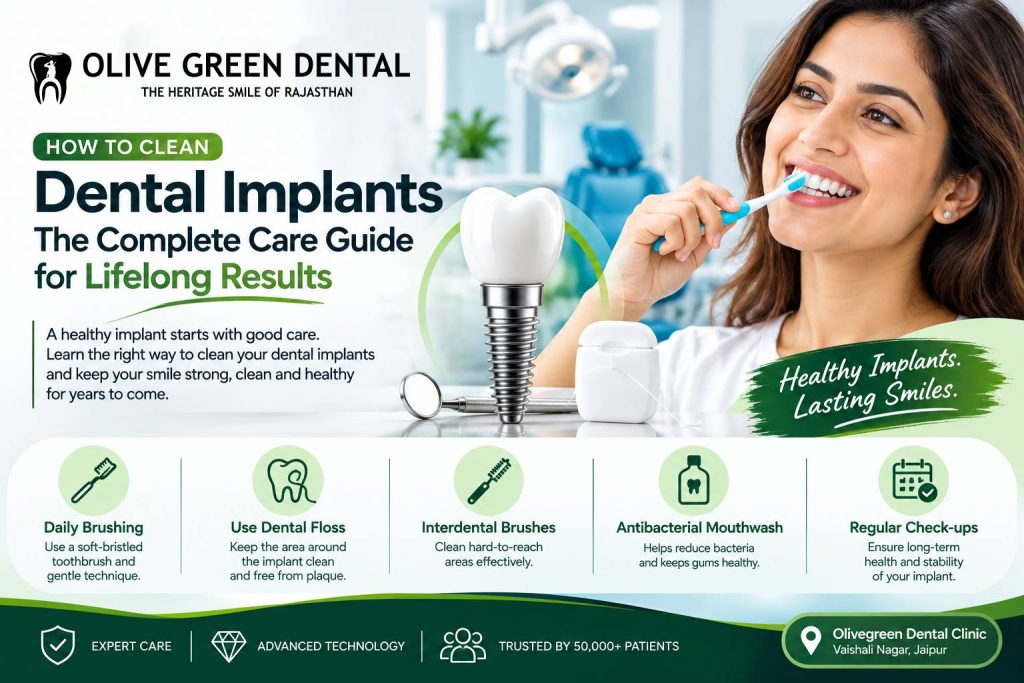
How to Clean Dental Implants: The Complete Care Guide for Lifelong Results
Dental implants are one of the greatest advances in modern dentistry — a permanent, natural-looking solution that replaces a missing tooth from root to crown. Yet even the best dental implant can fail prematurely if it is not cleaned and maintained correctly. At Olivegreen Dental Clinic, Vaishali Nagar, Jaipur, we see patients every week who are unsure exactly how to clean dental implants at home and when to visit their dentist for a professional check-up. In this detailed guide, Lt. Col. Dr. Dinesh Bansal (Retd.), founder of Olivegreen Dental Clinic and a retired officer of the Indian Army Dental Corps, shares everything you need to know to keep your dental implants healthy, clean, and functional for life.
Furthermore, understanding the right care routine from day one is what separates patients who enjoy their implants for 25+ years from those who experience complications within a few years. The good news is that implant care is simpler than most people expect — it simply needs to be done consistently and correctly.
What Are Dental Implants and Why Are They Necessary?
A dental implant is a small titanium post surgically placed into the jawbone to replace the root of a missing tooth. Once the implant fuses with the bone — a process called osseointegration — a natural-looking ceramic or zirconia crown is attached on top. The result is a replacement tooth that looks, feels, and functions exactly like your natural tooth.
Moreover, dental implants are not merely a cosmetic choice. They are a necessary medical intervention for patients with missing teeth because a gap in your smile does far more damage than it appears:
- Jawbone loss — when a tooth root is absent, the jawbone beneath it begins to shrink (resorb) within months. Implants are the only tooth replacement that prevents this bone loss.
- Adjacent teeth shift — neighbouring teeth tilt and drift into the empty space, misaligning your bite and causing jaw pain.
- Chewing difficulty — a missing tooth forces you to chew unevenly, increasing stress on remaining teeth and the jaw joint.
- Speech changes — gaps between teeth can cause slurring, whistling, or lisping that affects confidence.
- Facial sagging — bone loss beneath the gum causes the face to sink inward prematurely, adding years to your appearance.
- Increased cavity risk — shifted teeth are harder to clean properly, dramatically increasing the risk of decay in adjacent teeth.
At Olivegreen Dental Clinic, Vaishali Nagar, Jaipur, Dr. Dinesh Bansal has restored the smiles, confidence, and chewing ability of hundreds of patients with dental implants — from single-tooth replacements to full-mouth rehabilitation. As a result, implants placed at our Vaishali Nagar clinic have transformed lives in ways that no denture or bridge can replicate.
How Long Do Dental Implants Last — and What Determines It?
A well-placed dental implant at Olivegreen Dental Clinic, Jaipur, can last 20 to 25 years — or even a lifetime — with correct daily care. The titanium implant post itself rarely fails; most implant complications arise from:
- Inadequate oral hygiene causing peri-implantitis (gum infection around the implant)
- Smoking, which impairs blood supply and healing around the implant site
- Grinding (bruxism) that puts excessive pressure on the implant crown
- Skipping professional maintenance visits to the dentist
- Using harsh abrasive toothpastes or incorrect cleaning tools on the implant surface
Your Complete Daily Dental Implant Cleaning Routine
Cleaning a dental implant is similar to cleaning a natural tooth — but there are important differences in technique and tools that make a significant difference to long-term implant health. Follow this routine every day without exception.
Step 1: Brush the Implant Crown — Technique Matters
Brush your implant crown twice daily — morning and before bed. Use a soft-bristled toothbrush and a low-abrasive, non-whitening toothpaste. Angle the brush at 45 degrees to the gumline and use gentle circular motions. Pay special attention to the gum margin around the implant — this is where bacteria accumulate and where peri-implantitis begins.
Step 2: Floss Around the Implant — Every Single Day
Standard floss can be awkward around implants. Instead, use implant-specific floss or super floss (which has a stiff end, a spongy section, and a regular floss section). Slide the stiff end under the implant crown, wrap the spongy floss around the implant post, and move it back and forth in a C-shape. This removes plaque from the narrow gap between the implant crown and the gum — an area that no toothbrush can reach effectively.
Step 3: Water Flosser or Interdental Brush — the Game Changer
A water flosser (oral irrigator) is one of the most effective tools for implant care. It uses a pressurised stream of water to flush out food particles and bacteria from around and beneath the implant crown — areas that are essentially impossible to clean with a toothbrush alone. Use it on the medium setting directed at the gumline around each implant after brushing and flossing.
Alternatively, or additionally, use interdental brushes (small conical or cylindrical brushes) to clean the spaces between the implant and adjacent teeth. Choose a size that fits snugly without forcing.
Step 4: Antibacterial Mouthwash — the Final Defence Layer
Rinse for 30 seconds with an alcohol-free antibacterial mouthwash after every cleaning session. Alcohol-free formulas are important because alcohol can dry the oral tissues and irritate the gum around the implant over time. Chlorhexidine mouthwash, used short-term, is highly effective during the healing period after implant placement — ask Dr. Bansal what is appropriate for your stage of healing.
The Complete Do's of Dental Implant Care
- Brush twice daily: Use a soft-bristled or electric toothbrush. Brush for at least 2 minutes every morning and before bed.
- Floss every day: Use implant-specific super floss or a floss threader. Daily flossing is non-negotiable for implant health.
- Use a water flosser: An oral irrigator is the best tool for flushing bacteria from beneath the implant crown at the gumline
- Use non-abrasive toothpaste: Choose a gel-based, low-abrasive toothpaste. Abrasive pastes scratch the implant crown surface and create micro-grooves where bacteria colonise
- Stay well hydrated: Drink plenty of water throughout the day. Dry mouth reduces saliva, which is your mouth's natural defence against bacteria.
- Eat a balanced diet: Include calcium-rich foods (dairy, leafy greens, sesame) and Vitamin D to support the bone surrounding the implant.
- Visit Dr. Dinesh Bansal every 6 months: Regular professional cleaning and implant assessment at Olivegreen Dental Clinic, Vaishali Nagar, is essential for long-term implant health.
- Wear a night guard if you grind your teeth: Bruxism generates forces of up to 250 kg — enough to fracture an implant crown or loosen the abutment screw over time. Dr. Bansal will provide a custom night guard.
- Report any discomfort immediately: Pain, swelling, or looseness around an implant should be reported to Dr. Dinesh Bansal at Olivegreen Dental Clinic, Jaipur, immediately — never ignore it.
- Rinse after meals: A quick rinse with water after every meal flushes away food particles and reduces the time bacteria spend in contact with the implant site.
The Critical Don'ts of Dental Implant Care
- Do not smoke or use tobacco: Tobacco is the single biggest risk factor for implant failure. Smoking reduces blood circulation to the gum and bone, impairs healing, and increases the risk of peri-implantitis by up to 400%. If you smoke, Dr. Bansal strongly advises quitting before implant placement.
- Do not use abrasive toothpaste: Whitening toothpastes, baking soda pastes, and charcoal toothpastes are too abrasive for implant surfaces. They scratch the glaze on the crown and create rough surfaces where biofilm (bacterial plaque) accumulates rapidly
- Do not use a hard-bristled toothbrush: Hard bristles damage the gum tissue around the implant and can scratch the implant crown. Always choose soft or extra-soft bristles.
- Do not bite on hard foods with the implant: Ice cubes, hard candy, unpopped popcorn kernels, and hard crusty bread can fracture the ceramic crown on the implant. Be mindful of what you bite with the implanted tooth, especially in the first year.
- Do not skip your dental check-up visits: Peri-implantitis is asymptomatic in its early stages — it causes no pain until significant bone loss has occurred. Only a professional examination and X-ray by Dr. Bansal at Olivegreen Dental Clinic, Vaishali Nagar, can detect it early.
- Do not use metal dental picks on the implant: Metal picks and scalers scratch the titanium implant surface, disrupting the smooth interface between implant and gum. Professional scaling at Olivegreen Dental Clinic uses specialised plastic or resin-tipped instruments specifically designed for implant surfaces.
- Do not ignore bleeding gums around the implant: Healthy gums around an implant should not bleed. Any bleeding during brushing or flossing is an early sign of peri-implant mucositis (mild gum inflammation) — the precursor to peri-implantitis. See Dr. Bansal immediately if you notice this.
- Do not ignore bleeding gums around the implant: Healthy gums around an implant should not bleed. Any bleeding during brushing or flossing is an early sign of peri-implant mucositis (mild gum inflammation) — the precursor to peri-implantitis. See Dr. Bansal immediately if you notice this.
- Do not use alcohol-based mouthwash long-term: Alcohol dries the oral mucosa and can irritate gum tissue around the implant over time. Choose an alcohol-free antimicrobial rinse for daily use.
- Do not try to tighten a loose crown yourself: If your implant crown feels loose or makes a clicking sound, do not attempt to tighten it yourself. Contact Olivegreen Dental Clinic, Vaishali Nagar, Jaipur, immediately. A loose abutment screw can usually be tightened easily at the clinic but worsens rapidly if ignored.
Warning Signs That Require an Immediate Dental Visit
In addition to your regular 6-monthly check-ups, contact Dr. Dinesh Bansal at Olivegreen Dental Clinic, Vaishali Nagar, Jaipur, immediately if you experience any of the following:
- Pain or throbbing sensation around the implant site — especially pain that gets worse, not better, over days
- Swelling, redness, or pus from the gum around the implant — these are signs of active infection
- Gum recession around the implant — if more of the implant post becomes visible, bone loss may be occurring
- A loose or wobbly implant crown — the abutment screw may have loosened
- The implant itself feels loose — this is a dental emergency requiring immediate assessment
- Persistent bad taste or bad breath specifically from the implant area — this can indicate infection
- Difficulty biting or a change in how your teeth fit together — this may indicate crown damage or loosening
When to Visit Dr. Dinesh Bansal for Implant Maintenance
Your professional implant maintenance schedule at Olivegreen Dental Clinic, Vaishali Nagar, Jaipur, follows a structured programme designed by Dr. Bansal based on your individual implant case and oral health status:
| Visit | Timing | What Dr. Bansal Checks |
|---|---|---|
| Post-operative check | 1 week after surgery | Healing, suture removal if needed, infection check |
| Early healing check | 1 month after surgery | Osseointegration progress, gum health, bite check |
| Crown placement check | After crown is fitted | Bite alignment, crown fit, gum adaptation |
| Routine maintenance | Every 6 months | Professional implant cleaning, X-ray, bone level check, gum health |
| Emergency visit | As needed — any warning sign | Immediate clinical assessment, treatment if required |
During each maintenance visit at Olivegreen Dental Clinic, Dr. Bansal uses specialised resin or plastic-tipped scalers — not standard metal instruments — to clean professionally around the implant without scratching the titanium surface or the ceramic crown. Consequently, this professional-level care is something you cannot replicate at home, no matter how diligently you brush.
Why Choose Olivegreen Dental Clinic for Dental Implant Care in Jaipur?
At Olivegreen Dental Clinic, Vaishali Nagar, Jaipur, dental implant treatment and long-term implant care is led personally by Lt. Col. Dr. Dinesh Bansal (Retd.) — a retired Lieutenant Colonel from the Indian Army Dental Corps, a graduate of MIDA Government Dental College and Hospital, Chennai, and Jaipur’s most trusted dental implant specialist. His military-trained discipline in precision, sterility, and systematic patient care translates directly into superior implant outcomes for every patient.
Additionally, Olivegreen Dental Clinic is equipped with the tools that implant care demands — digital X-rays for bone level monitoring, a Class B autoclave for instrument sterilisation that matches Army standards, and an intraoral camera that shows patients exactly what is happening around their implants in real time.
- 310+ verified 5-star Google reviews from patients across Vaishali Nagar and Jaipur
- Army-standard sterilisation protocols — Class B autoclave, single-use disposables
- Digital X-rays for accurate bone level monitoring around implants
- Specialised implant maintenance tools — plastic-tipped scalers, implant-specific cleaning equipment
- Personalised 6-monthly implant maintenance programme for every implant patient
- Transparent, honest communication — Dr. Bansal explains every finding in plain language
- Convenient location: Near Mall of Jaipur, Roshan Marg, Vaishali Nagar — easy access from Mansarovar, Pratap Nagar, C-Scheme and across Jaipur
Frequently Asked Questions About Dental Implant Care
Q: How often should I clean my dental implant?
You should clean your dental implant at least twice daily — brushing with a soft-bristled toothbrush in the morning and before bed, and flossing around the implant at least once per day. Additionally, use a water flosser and antibacterial mouthwash as part of your daily routine. Furthermore, visit Dr. Dinesh Bansal at Olivegreen Dental Clinic, Vaishali Nagar, Jaipur, every 6 months for a professional implant cleaning and check-up.
Can I use a regular toothbrush on my dental implant?
Yes, but choose a soft or extra-soft bristled toothbrush only. Hard or medium bristles can damage the gum tissue around the implant and scratch the ceramic crown surface. An electric toothbrush with a soft round head is especially recommended by Dr. Bansal for implant patients as it removes plaque more effectively at the gumline with less manual pressure required.
What happens if I don't clean my dental implant properly?
Neglected implants develop bacterial plaque along the gumline, which leads to peri-implant mucositis — reversible gum inflammation — and, if untreated, progresses to peri-implantitis, which involves irreversible bone loss around the implant. In severe cases, the implant may need to be removed. Proper daily cleaning and 6-monthly professional maintenance at Olivegreen Dental Clinic, Jaipur, prevents this entirely.
Can I eat normally with a dental implant?
Yes. One of the major advantages of dental implants is that they allow you to eat virtually any food — unlike dentures, which require dietary restrictions. However, Dr. Bansal advises patients to avoid biting on extremely hard foods directly with the implant crown (such as ice cubes or very hard bones), as this can fracture the ceramic crown over time.
How long do dental implants last with proper care?
With correct daily home care and regular 6-monthly professional maintenance visits to Olivegreen Dental Clinic, Vaishali Nagar, Jaipur, dental implants can last 20 to 25 years or a lifetime. The titanium implant post is typically permanent; the crown on top may need replacement after 15 to 20 years depending on wear. Smoking, poor oral hygiene, and skipping dental visits are the main causes of premature implant failure.
Is it normal to feel pain around the implant after the procedure?
Some discomfort and mild swelling for 3 to 5 days following implant surgery is normal and expected. However, pain that worsens beyond day 5, or new pain that develops weeks or months after a healed implant, is not normal and requires immediate assessment by Dr. Bansal at Olivegreen Dental Clinic, Vaishali Nagar, Jaipur. Do not wait — early treatment prevents serious complications.
What type of toothpaste is best for dental implants?
Use a low-abrasive, non-whitening, gel-based toothpaste. Avoid whitening toothpastes, charcoal toothpastes, and baking soda formulas — these are too abrasive for implant surfaces. A toothpaste with fluoride for general dental health is appropriate for implant care. Dr. Bansal can recommend a specific brand during your consultation at Olivegreen Dental Clinic, Vaishali Nagar, Jaipur.
Does Dr. Dinesh Bansal in Vaishali Nagar, Jaipur, provide dental implants?
Yes. Dr. Dinesh Bansal at Olivegreen Dental Clinic, Vaishali Nagar, Jaipur, is one of the most experienced dental implant specialists in Jaipur. He provides the complete implant journey — from initial consultation, digital 3D scanning, implant placement, and crown fitting, through to long-term maintenance. His 310+ 5-star Google reviews reflect consistently excellent implant outcomes for patients across Vaishali Nagar, Mansarovar, Pratap Nagar, and greater Jaipur.
Conclusion — Your Implant Is a Lifetime Investment Worth Protecting
Dental implants are the most advanced, durable, and natural-feeling tooth replacement available today — and with the right daily care routine, they can truly last a lifetime. Above all, the most important thing you can do for your implant is simple: brush twice daily, floss every day, avoid harmful habits, and visit Dr. Dinesh Bansal at Olivegreen Dental Clinic, Vaishali Nagar, Jaipur, every 6 months.
Consequently, patients who follow the routine in this guide — combined with professional maintenance at our Vaishali Nagar clinic — have implants that continue to perform beautifully decades after placement. Your implant is a lifetime investment. Protect it with the daily care it deserves, and it will give you a lifetime of confident, comfortable smiles
Book Your Dental Implant Check-Up at Olivegreen Dental Clinic
Call / WhatsApp: +91-8112276936 ·
Vaishali Nagar, Near Mall of Jaipur, Jaipur
· Mon–Sat: 10 AM – 7 PM.